

How to Choose the Right Industrial Hose for Your Application
Quick Answer
Choose an industrial hose by matching seven variables to your application: size, temperature, the media conveyed, material compatibility, working pressure, end fittings, and delivery conditions. Get one wrong and the assembly fails early. When unsure, spec to the harshest condition the line will ever see, not the average.
Specifying a hose looks simple until the wrong one ruptures over a running pump at 2 a.m. A catalog photo rarely tells you whether a hose will survive a 180°F caustic wash, a vacuum suction line, or a coupling that cycles 600 times a shift. The gap between a five-year assembly and a five-week failure is almost always in the specification — not the purchase price.
This guide walks plant and purchasing teams through the decisions that actually move the needle: the variables that qualify any hose, how the common materials compare in real service, and the mistakes that turn a routine reorder into an incident report.
The Seven Variables That Decide Every Hose Selection
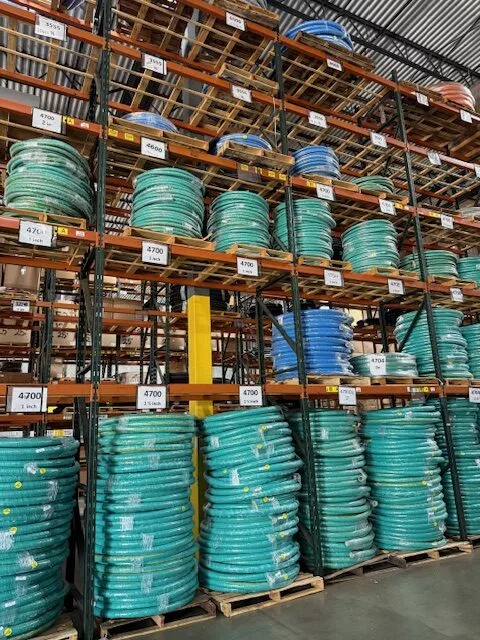 Distributors and engineers qualify any assembly against a simple checklist often called STAMPED. Skip a letter, and you are guessing.
- Size: Inner diameter governs flow and velocity; outer diameter and length affect routing and bend radius. Undersizing chokes flow and spikes pressure.
- Temperature: Both the media and ambient temperatures matter. A hose rated for 200°F media in a 70°F shop may be derated badly when it runs beside a furnace or steam line.
- Application: Suction, discharge, transfer, vacuum, or pulsation — each loads the hose differently. A discharge hose pulled into vacuum service will collapse.
- Media: The exact chemical, food product, slurry, or gas, including concentration. “Acid” is not a spec; “37% hydrochloric acid at 120°F” is.
- Pressure: Maximum working pressure plus surge. Confirm the safety factor (commonly 4:1) and never run continuously near the burst rating.
- Ends: Fitting style, material, and attachment method. The coupling is part of the assembly, not an afterthought.
- Delivery: Quantity, lead time, testing, tagging, and the certifications you need on the dock.
Document each of these before you open a single product page. It is the fastest way to narrow hundreds of options down to three real candidates — and it gives whoever quotes the assembly everything they need on the first call.
Matching Hose Construction to the Job
Material is where most teams either overspend or under-protect. Here is how the common families compare once they are in service rather than on paper:
- Rubber hose is the workhorse for water, air, mild chemicals, abrasives, and bulk material handling. It is tough and economical, but it has clear limits with aggressive chemistries and sustained high heat.
- PVC hose is lightweight, often clear, and cost-effective for water, air, and light-duty transfer where flexibility and visual flow monitoring matter more than pressure.
- PTFE hose is nearly chemically inert, handling aggressive acids, solvents, and high temperatures that quickly destroy elastomers. It is the premium choice when compatibility is non-negotiable.
- Metal hose delivers zero permeation and extreme temperature tolerance for steam, cryogenics, and hot hydrocarbons where polymers simply cannot survive.
- Silicone hose excels in high-temperature, sanitary, and food or pharmaceutical transfer thanks to its inertness and wide temperature band.
- Composite hose is light, flexible, and well suited to in-plant and dockside transfer of fuels and chemicals, with redundancy built into its layered construction.
For lines that move bulk liquids or dry product, the suction hose and discharge hose categories separate reinforced, vacuum-rated builds from lighter discharge-only designs — a distinction that matters the instant a pump pulls vacuum on the line.
When to Spec Up — and When You Are Overpaying
A more expensive hose is not automatically a safer hose. It is safer only when the application demands it.
- Spec up when the media is aggressive, the temperature swings, the line sees pressure surges or vacuum, or a failure would halt production or trigger a release. PTFE or metal earns its cost here.
- Do not over-spec a plain water or compressed-air line with PTFE. You will pay a premium for chemical resistance you never use, and a stiffer hose can complicate routing in a tight skid.
- Right-size the reinforcement to the real working pressure plus surge, not the pump’s dead-head rating “to be safe.” Excess reinforcement reduces flexibility and increases minimum bend radius.
The discipline is simple: spec to the worst condition the hose will actually see, then stop.
Flow, Velocity, and Bend Radius: The Details That Bite
Three sizing details quietly decide whether a correctly chosen hose actually performs:
- Inner diameter and velocity: Too small a bore drives fluid velocity up, which raises pressure drop and accelerates internal erosion on abrasive or high-flow lines. Size for the target velocity, not just “whatever matches the pump port.”
- Minimum bend radius: Every hose has one. Route it tighter and you kink the tube, restrict flow, and fatigue the reinforcement at the bend — a failure that looks like a defect but is really an installation error.
- Length and slack: Too short and the hose is in constant tension; too long and it drags, abrades, or kinks. Allow for movement, thermal growth, and pressure-induced length change.
These are the factors that turn a hose that passed every spec on paper into one that fails in the rack.
A Field Example Most Plants Will Recognize
A processor swaps a failed transfer line and grabs a general-purpose rubber hose off the shelf because it “looks the same.” The line handles a 30% sodium hydroxide solution at 150°F. Within two weeks the tube softens, the bore swells, and flow drops. Maintenance writes it off as a bad hose. The hose was fine — the spec was wrong. A PTFE-lined or properly selected chemical hose would have run for years. The cheaper hose was the most expensive option on the floor once you count the downtime and the cleanup.
The mirror-image mistake is just as common: a team installs a stiff, heavily reinforced hose on a low-pressure suction line “to be safe,” only to find it will not seat to the fitting and kinks at the first bend. Both failures come from skipping the same step — defining the conditions before choosing the hose.
What Goes Wrong When the Spec Is Off
Every shortcut in selection eventually shows up as a failure mode:
- Chemical mismatch causes tube swelling, softening, or cracking, sometimes within hours.
- Under-rated pressure leads to bulging, reinforcement burst, or a coupling blowing off.
- Ignoring vacuum collapses a discharge hose and starves the pump.
- Wrong bend radius kinks the hose, restricting flow and fatiguing the reinforcement.
- Mismatched fittings create leak paths and the risk of a hose pulling off under pressure.
None of these are exotic. They are the predictable result of choosing on price or habit instead of conditions. A short conversation with an application specialist — describing the media, temperature, and pressure — eliminates nearly all of them before a hose is cut.
Why Plant and Purchasing Teams Partner With J.W. Roberts
Hands-on application expertise. As a multi-generational hose distributor with more than half a century in the field, J.W. Roberts has matched hose to application across agriculture, chemical, food, offshore, and petroleum operations. Application consultants help you work through the variables before you buy, not after a failure.
Reliability you can schedule around. A 50,000-square-foot Houston warehouse stocks a full range of industrial hose types ready to ship, so a critical assembly does not sit for weeks in a manufacturer’s queue.
Quality from manufacturers the industry trusts. Product comes from world-class names backed by the testing, tagging, and certifications that regulated plants require on every assembly.
Coverage built around the Gulf Coast and beyond. Based in Houston and shipping nationwide, J.W. Roberts pairs local responsiveness with the inventory depth large facilities need. Browse the current hose inventory or contact the team to spec your next assembly.
Frequently Asked Questions
What is the most common mistake when selecting an industrial hose?
Specifying by media name alone. “Acid” or “oil” is not enough — concentration, temperature, and pressure all change which tube material survives. The fix is documenting every STAMPED variable before you choose.
How do I know what pressure rating I actually need?
Take the maximum working pressure of the system, add any surge or water-hammer spikes, and confirm the hose’s published working pressure — not its burst pressure — exceeds it with the rated safety factor, typically 4:1.
Can one hose handle both suction and discharge?
Only if it is built and rated for both. Vacuum service requires reinforcement that resists collapse. Many discharge-only hoses flatten under suction, so confirm the vacuum rating before any dual-service use.
Is a more expensive hose always the safer choice?
No. The safest hose is the one matched to the conditions. Over-specifying a water line with PTFE wastes budget, while under-specifying a chemical line risks a release. Match the build to the application, then stop.