

Industrial Breakaway Hose Couplings for Industrial Hose Applications
For added safety for industrial hose applications, we offer high quality breakaway hose couplings from world-class manufacturers. We are experts in industrial hose assemblies and applications and can help you find the right coupling for the job. Couplings from us help give peace of mind for operational safety and efficiency.
Breakaway hose couplings are safety couplings to help prevent driveaway and pull away accidents. These couplings are designed to separate before forces become high enough to cause accidents like hose breakage. Most safety breakaway couplings feature automatic closures. When the couplings reach a certain stress point, the two halves of the coupling break apart while at the same time the internal valves close on both sides to prevent spills and leakage.
Safety breakaway couplings are popular for transferring materials that may be hazardous for humans or the environment and are commonly found in chemical transfer, oil and gas transfer, and many other applications. Where spillage does not pose serious hazards, such as clean water transferring, non-closure breakaway couplings are available as a more economical option.
Breakaway couplings typically use one of two mechanisms to cause coupling separation. Break bolt or break stud couplings utilize bolts designed to break under a specified force. On couplings connecting two industrial hoses, the break bolts typically separate with straight pull forces. For couplings connecting a fixed point with an industrial hose, typically the break bolts will separate with angular forces up to a 90° angle.
By contrast, breakaway couplings can also utilize cable release mechanisms. These are preferred when break bolts require more pressure for separation than is safe for the application. Cable-release breakaway couplings offer separation at lower forces. These couplings are held together by internal cables instead of by bolts, which then break at specified forces.
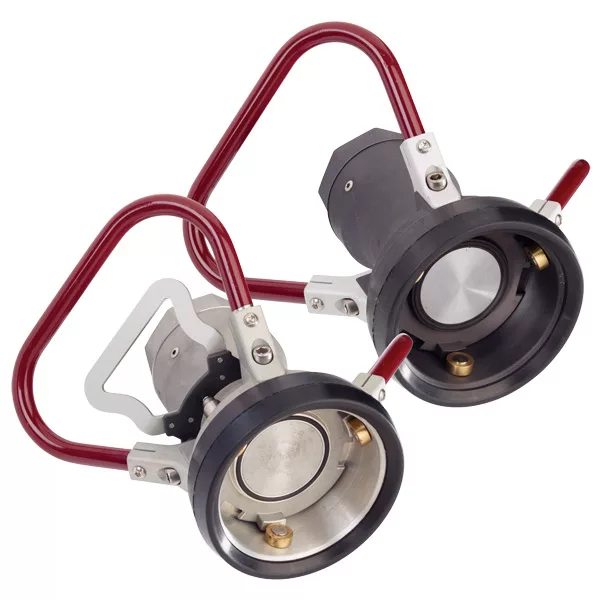
Why Choose Breakaway Hose Couplings
- Reliable Operation: The simple design of the coupling ensures reliable operation in even the most demanding of environments.
- Very Low Loss: Positive shut-off of both coupling halves results in minimum product loss.
- Proven Design: Supplied to blue-chip companies throughout the world.
- Break Load Individually Calculated: Computer modeling of your particular application results in a reliable determination of break load.
- Manufactured to the Highest Quality: Quality control system approved to ISO9001. All parts have full traceability.
How to Choose Between Break Bolt and Cable-Release Couplings
Selecting the right breakaway mechanism comes down to the forces involved in your specific application and how much margin you need before separation occurs.
Break bolt couplings work well when the connected hose or line is subject to fairly predictable, moderate pull forces. Because the bolts are engineered to shear at a set load, they’re a good fit for applications where a slightly higher release threshold is acceptable — think fixed loading arms, tanker truck connections, or dock-to-vessel transfers where a sudden but controlled separation is the goal.
Cable-release couplings, on the other hand, are the better choice when personnel or equipment could be at risk from the higher forces a break bolt requires to separate. Because the internal cable can be tuned to release at lower loads, these couplings are common in tighter-tolerance environments — near walkways, in congested plant piping, or anywhere a lower-force, faster-reacting safety response is preferred over raw holding strength.
If you’re not sure which mechanism fits your setup, that’s exactly the kind of question our applications team is set up to answer — bring us your line size, media, expected pressure, and pull direction, and we’ll help you land on the right option.
Common Applications for Breakaway Hose Couplings
- Tank truck and railcar loading/unloading — protects against driveaway incidents when a vehicle pulls away before the hose is disconnected.
- Marine and dock transfer operations — accommodates vessel movement from tides, wind, and current without risking a hose rupture.
- Chemical plant transfer lines — limits spill volume and protects personnel when a line is over-stressed or accidentally struck.
- Fuel and petroleum distribution — a standard safety component at many terminals and fueling stations, where regulatory and insurance requirements often call for breakaway protection.
- Agricultural and bulk liquid transfer — reduces product loss and equipment damage during field operations where hose snagging is common.
How to Size and Select the Right Industrial Hose Coupling
Break load isn’t a one-size-fits-all number. Every application we quote is evaluated individually, factoring in:
- Line pressure and flow rate — higher operating pressures typically call for a higher engineered break load to avoid nuisance separations during normal operation.
- Hose size and material — the coupling has to match your existing hose end connections and pressure rating.
- Direction of expected pull — straight-line pulls and angular pulls place different stresses on the coupling, which affects whether a break bolt or cable-release design is more appropriate.
- Media being transferred — hazardous, corrosive, or environmentally sensitive materials generally call for closure-style couplings that shut off both sides on separation, rather than the more economical non-closure option.
Because break load is calculated per application rather than pulled from a generic chart, getting the sizing right up front is what keeps a breakaway coupling doing its job — separating when it should, and staying put when it shouldn’t.
Industrial Hose Couplings from J.W. Roberts Co.
When you need hose couplings, we have solutions for your needs. J.W. Roberts Co. warehouses and distributes many different kinds of breakaway couplings for industrial applications. A majority of the couplings we carry are produced by Alpha Process Controls, the premier manufacturer of safety breakaway couplings. We are proud to serve customers throughout Texas, Louisiana, Arkansas, and Oklahoma by providing superior industrial hose products for heavy-duty service.
Our team can help identify which coupling is right for your application. Just reach out to discuss your needs with our industrial hose application specialists and we can help you find the most practical and cost-effective hose coupling product.
Because we maintain a large inventory in our warehouse, we offer quick delivery timelines for all our products, including high quality breakaway hose couplings. In some cases, we can even ship out your order the very same day for seriously fast delivery.
Contact us now to find the right hose coupling for your assembly.
Frequently Asked Questions
Do breakaway couplings stop all product loss when they separate? Closure-style breakaway couplings are designed to seal both halves automatically on separation, minimizing spillage. Non-closure versions do not seal and are typically reserved for applications where the transferred material poses little environmental or safety risk, such as clean water.
Can a breakaway coupling be reset and reused after it separates? In most cases, yes — the two halves can be reconnected and, depending on the design, the bolts or cable replaced, allowing the coupling to go back into service. We can walk you through reset procedures for the specific model you’re using.
How do I know what break load I need? This depends on your line pressure, hose size, pull direction, and the media being handled. Our applications team uses computer modeling to calculate a reliable break load for your specific setup rather than relying on generic ratings.
Are breakaway couplings required by regulation? Requirements vary by industry and application. Many fuel transfer and chemical handling operations include breakaway protection as part of their safety program or insurance requirements. Check with your compliance team or reach out to us if you need help understanding what applies to your operation.