

Chemical Transfer Hose Selection for Chemical Plants
Quick Answer
Select a chemical transfer hose by verifying tube compatibility against the exact chemical, concentration, and temperature, then confirming the pressure rating, permeation resistance, and compatible fittings. For aggressive acids and solvents, PTFE or metal is usually the safe answer; never substitute on compatibility to save cost.
In a chemical plant, the hose is often the weakest link between a tank, a pump, and a railcar — and the one most exposed to operators. A wrong selection does not just leak; it can release a hazardous chemical, expose workers, and put the plant in front of OSHA and the EPA. Hose selection here is a safety decision first and a procurement decision second.
This guide covers what actually determines whether a chemical hose survives, where the costly substitutions happen, and the safety details — conductivity, testing, and documentation — that selection alone does not capture.
Chemical Compatibility Is the First and Last Word
Before pressure, before size, before price, the tube material has to be compatible with the media as it actually flows. Three details decide it:
- The exact chemical: Trade names and families are not enough. Sulfuric acid behaves nothing like hydrofluoric acid even though both are “acid.”
- Concentration: A material that resists a dilute solution may fail at high concentration — and some chemicals are more aggressive diluted than concentrated.
- Temperature: Compatibility ratings drop as temperature rises. A tube rated at ambient may not survive the same chemical at process temperature.
Always check the media against a published compatibility chart at the real concentration and temperature, and confirm the rating with a specialist rather than assuming. A single wrong assumption here is what causes most chemical hose failures.
Tube Materials Ranked by Chemical Resistance
Material families line up roughly by how aggressive a chemistry they tolerate:
- PTFE hose sits at the top for breadth of resistance — it handles strong acids, bases, and solvents that destroy elastomers, across a wide temperature range. A smooth bore PTFE hose resists buildup and cleans easily, while a convoluted, stainless-braided PTFE hose adds flexibility and burst strength for tighter routing.
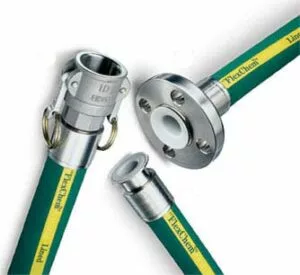
- Composite hose offers broad chemical and fuel compatibility with light weight and excellent flexibility, with multiple film and fabric layers providing built-in redundancy for transfer and dockside service.
- Metal hose handles chemistries and temperatures — including hot and corrosive media or cryogenics — where every polymer is out, and it provides zero permeation for the most hazardous transfers.
- Rubber hose with the correct tube compound (such as EPDM or specialized blends) remains economical for many mild and moderate chemistries, but its limits arrive fast with strong oxidizers and solvents.
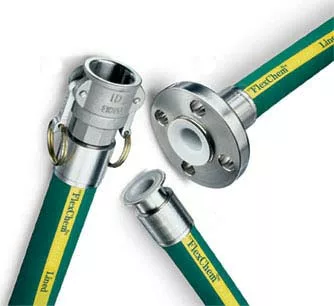
Use the broader hose type families as a starting map, then narrow by the specific chemistry.
Pressure, Temperature, and the Permeation Problem
Compatibility gets a hose onto the shortlist; three more factors keep it safe in service:
- Working pressure plus surge: Confirm the published working pressure exceeds system pressure with the rated safety factor, and account for pump pulsation and valve-closure spikes.
- Temperature derating: A hose loses pressure capacity as temperature climbs. Use the rating at operating temperature, not the headline number.
- Permeation: Some chemicals migrate slowly through polymer walls even without a leak, degrading the reinforcement, off-gassing, or saturating insulation. Where permeation is unacceptable, metal or a barrier-layer construction is the answer.
When the Wrong Hose Means an Environmental Release
The failure modes in chemical service are the ones that make the news:
- Tube swelling or dissolution from an incompatible chemical, narrowing the bore or breaching the tube.
- Embrittlement and cracking from solvent attack or thermal cycling.
- Coupling blow-off when fittings are mismatched or improperly attached — the most common cause of sudden chemical sprays.
- Permeation-driven failure where the reinforcement is attacked from inside while the tube still looks intact.
Pair every chemical assembly with compatible, properly attached fittings, and consider dry break couplings on transfer points to prevent spills during connection and disconnection. The coupling is part of the safety system, not a commodity add-on.
Decision guidance: choose PTFE for the widest range of aggressive acids, bases, and solvents; choose composite for flexible transfer of fuels and many chemicals at moderate pressure; choose metal when temperature, permeation, or the hazard level rules out polymers entirely. Reserve rubber for genuinely mild and moderate chemistries, and verify every choice against concentration and temperature.
Concentration and Temperature Change Everything
The same chemical can call for two different hoses depending on its state. A few patterns chemical teams see constantly:
- Sulfuric acid is relatively manageable for some materials when concentrated but far more aggressive when diluted — the opposite of most engineers’ intuition.
- Sodium hypochlorite (bleach) attacks many elastomers and metals, quietly degrading a hose that looked fine on a generic chart.
- Hydrocarbons and aromatic solvents swell and soften rubber tubes that handle water without complaint.
- A rise from ambient to process temperature can drop a material from “compatible” to “not recommended.”
This is why a chemical name alone never finishes the selection. Verify the exact compound at its real concentration and operating temperature, every time.
A Scenario Chemical Teams Will Recognize
A plant adds a transfer line for a concentrated acid and reuses a hose spec that worked on a similar-looking service elsewhere in the unit. The new line runs hotter, and the acid is a different compound. Within days the tube discolors and the cover begins to weep at a low point where the hose was routed below the minimum bend radius. It is caught on a walkdown before it breaches — this time. The root cause is not a defective hose; it is three skipped checks: compound, temperature, and routing. Re-specifying to a PTFE-lined assembly, rated at operating temperature and routed within its bend radius, turns a recurring near-miss into a line that runs for years.
Static, Grounding, and Conductivity
Moving solvents, fuels, and many chemicals generates static electricity. If that charge is not carried safely to ground, it can discharge and ignite a flammable atmosphere — a hazard that has nothing to do with chemical compatibility and everything to do with safety.
- Specify a hose with a conductive or static-dissipative path appropriate to the media and environment.
- Ensure electrical continuity through the fittings so the assembly is grounded end to end.
- Bond and ground equipment at transfer points, particularly when loading or unloading tankers and totes.
On flammable service, conductivity is not an upgrade — it is part of the specification.
Assembly, Testing, and Documentation for Hazardous Service
A chemical hose is only as trustworthy as its assembly and its paperwork:
- Hoses should be assembled with the correct fittings and attachment method, then pressure-tested before they ever see service.
- Critical assemblies benefit from tagging that records the spec, test date, and pressure rating so operators can verify the right hose is on the right line.
- Traceability and test certificates support both safety reviews and regulatory expectations under OSHA and EPA programs.
Treat the certificate and the tag as part of the deliverable, not an afterthought.
Why Chemical Operations Trust J.W. Roberts
Deep chemical-transfer experience. J.W. Roberts supports chemical operations and petroleum processing across the Gulf Coast, where the cost of a wrong hose is measured in releases, not just downtime.
Compatibility-first guidance. Application consultants work from the actual chemical, concentration, and temperature — the disciplined approach that prevents the substitution errors behind most chemical hose failures.
Engineered product, properly assembled. PTFE, composite, and metal hose come from leading manufacturers and are matched with compatible fittings and couplings, because a chemical assembly is only as safe as its weakest connection.
Gulf Coast inventory, nationwide reach. A 50,000-square-foot Houston warehouse keeps chemical-rated hose ready to ship, with a multi-generational track record behind every order. Browse the hose inventory or contact the team to qualify a chemical transfer assembly.
Frequently Asked Questions
Why is the same chemical hose not safe for every acid?
Because compatibility is chemical-specific. A tube that resists one acid can be destroyed by another, and concentration and temperature shift the result. Always verify the exact chemical at its real concentration and operating temperature.
When should I choose PTFE over a rubber chemical hose?
Choose PTFE when the media is a strong acid, base, or solvent, when temperatures are high, or when broad compatibility across changing chemistries matters. Rubber is economical for mild and moderate chemistries but reaches its limits quickly with aggressive media.
What is permeation and why does it matter?
Permeation is the slow migration of a chemical through the hose wall without a visible leak. It can degrade the reinforcement, off-gas, or saturate insulation. Where it is unacceptable, use metal hose or a barrier-layer construction.
Do couplings really matter that much on chemical lines?
Yes. Coupling blow-off is a leading cause of sudden chemical sprays. Fittings must be compatible and correctly attached, and dry break couplings can prevent spills during connection and disconnection at transfer points.